
Blog

Table of Contents
.webp)
If water is coming through your ceiling, call a water damage restoration company first — not a plumber. A restoration company handles both the water already inside your ceiling and the coordination to stop the source, while a plumber only fixes the pipe and leaves the wet drywall and insulation for you to deal with.
.webp)
I've been doing this for over 25 years, and the call I get most often starts the same way: "There's a brown spot on my ceiling and I don't know who I'm supposed to call."
It's a fair question, and the internet gives you five different answers. Plumber. Roofer. Handyman. Insurance. Restoration company. Meanwhile water is still moving through your house.
So here's the direct answer, and it's the same one I'd give my own neighbor. Who to call for a water leak in ceiling situations is a water damage restoration company — because we're the only trade that handles the water that already got in. A plumber stops the leak. A roofer patches the roof. Neither of them dries the ceiling cavity, and that's where the real damage lives.
I'm Dale See, President of PHG Restoration Services here in Dublin. Below is exactly what I'd tell you on the phone at 9pm on a Tuesday, including the parts that don't make us any money.
Call a water damage restoration company first, then let them coordinate the source repair. We answer 24/7, we're on site the same day, and we can tell you within minutes whether you're looking at a small dry-out or a real loss.
A plumber is the right call for the pipe, but the pipe is only half the problem. The IICRC S500 standard that governs professional restoration work draws this line clearly: finding and correcting the source of the water is the property owner's responsibility, while the restorer's job is the damage that water caused.
In practice, that means a plumber will cut a hole, fix the fitting, and hand you an invoice. The soaked insulation above your drywall is still soaked. Two weeks later you're calling us anyway, except now you have mold.
We find where the water actually went — which is almost never where the stain is. We use moisture meters and thermal imaging to map the wet area, then set drying equipment to pull it out of the framing and cavity.
We also document everything with photos and readings before we touch anything, which matters enormously if you end up filing a claim.
"The stain on your ceiling is the smallest part of the problem. Water runs along the joists and drops wherever gravity lets it, so the wet spot you're looking at might be six feet from where it actually came in. That's the part homeowners can't see, and it's the part that grows mold."
If you already know the source — a visible burst supply line under a second-floor sink, say — call the plumber to shut it down, then call us. We'll work alongside them. That's a normal Tuesday for us.
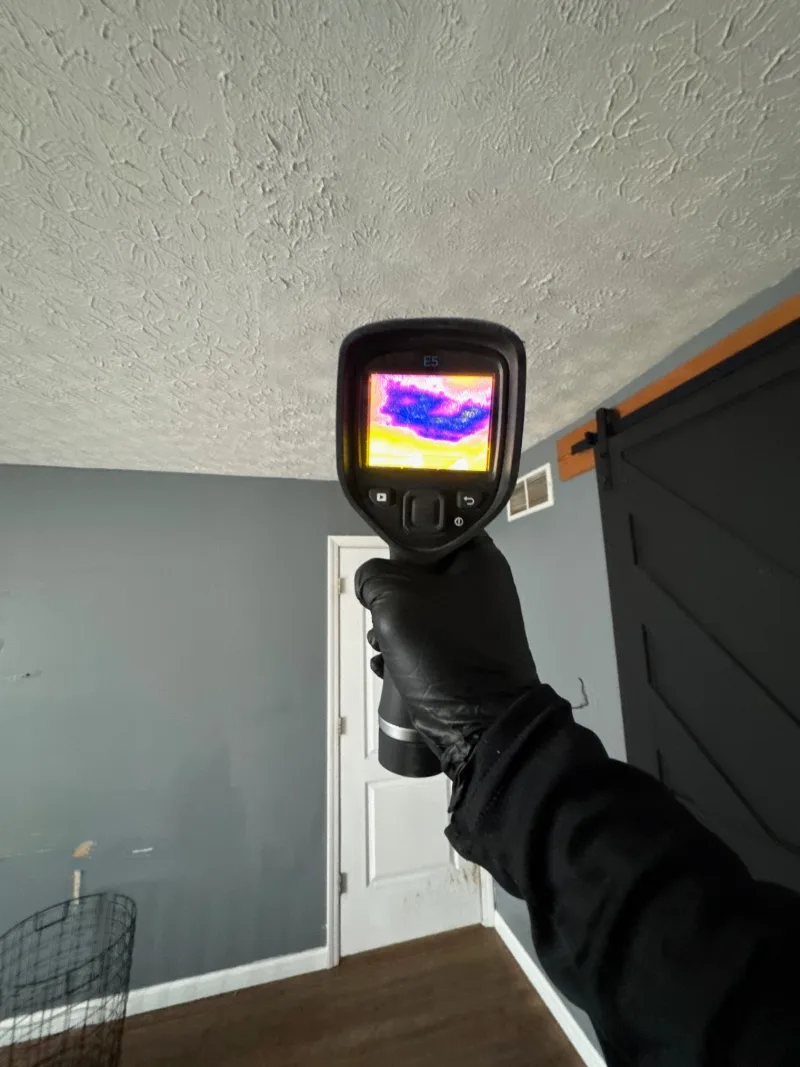
Yes. A ceiling leak is an emergency because of three things happening at once: electrical risk, structural risk, and the mold clock.
If water is anywhere near a light fixture, ceiling fan, vent, or smoke detector, kill power to that room at the breaker panel — not at the wall switch — before you do anything else. Don't touch the fixture. Don't stand in the water underneath it while you reach for the switch.
This is the one part of the whole process where waiting for a professional isn't the safe move. Turn the breaker off, then call.
If your drywall is sagging or bulging, there's standing water pooling above it. A saturated section of ceiling can come down all at once, and it comes down heavy.
Get everyone out from under it, move furniture if you can do it safely, and put a bucket down. Don't go poking at it with a broom handle — I've seen that end badly.
The EPA is specific on this: dry wet materials within 24 to 48 hours and in most cases mold won't grow. Miss that window and you've turned a drying job into a mold remediation job.
That's not a scare tactic, it's just the timeline. It's also why we push to get out same day rather than scheduling you for Thursday.
Get safe, slow the water, and start documenting — in that order. Make the call early, too. Which company you pick matters far less than making the call inside the first hour.
Cut power to the room at the breaker. Shut off your main water valve if the leak looks like plumbing rather than roof. Move electronics, rugs, and furniture out of the drip zone.
Photograph the ceiling, the drip, the puddle, and anything damaged underneath. Take a short video too. Insurance adjusters work from evidence, and the evidence disappears the second you start mopping.
Don't run a box fan pointed at a wet ceiling before anyone's assessed it — if the water isn't clean, you're aerosolizing it through the house. Don't paint over the stain. And don't cut into the drywall yourself hoping to find the leak.
"Homeowners ask me all the time if they should cut the ceiling open to let it drain. My honest answer is no — not because we want the work, but because you can't see what's behind it. There's wiring up there. I've had guys open a ceiling and find a junction box sitting in a puddle."
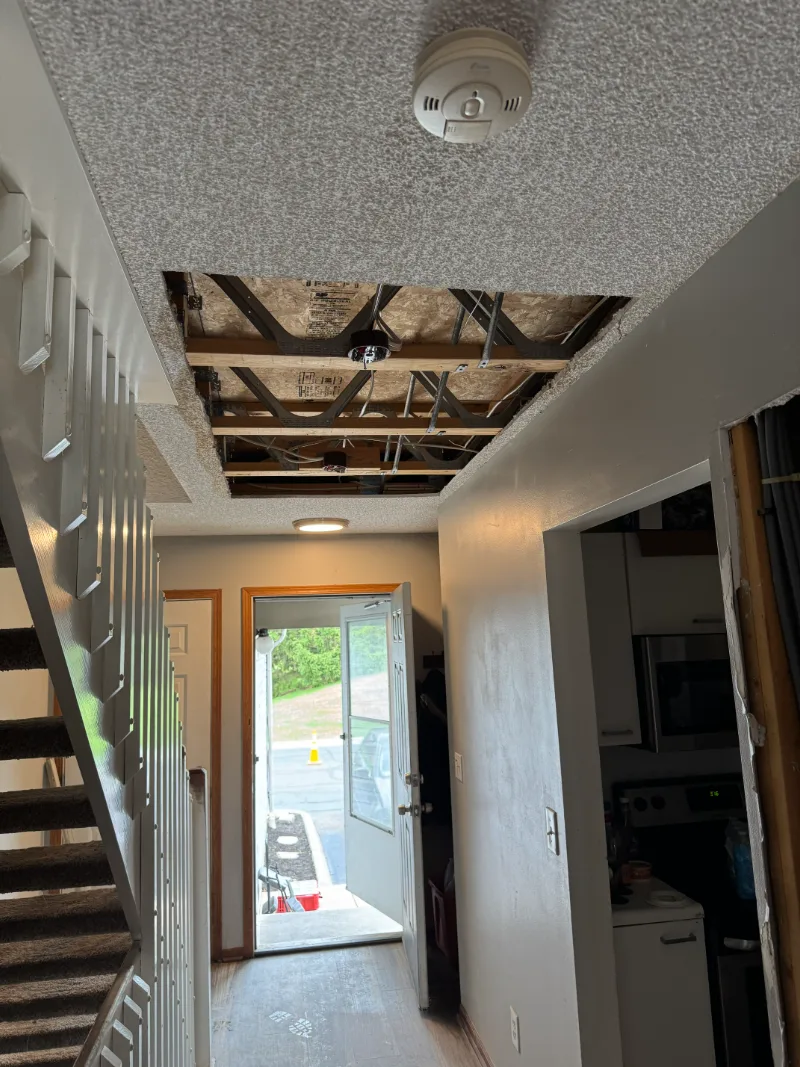
The answer is the same regardless of where the water shows up. Whether you're searching who to call for water leak in floor damage, who to call for water leak in house cavities you can't see into, or a leak behind a wall, restoration is still the right first call — the damage mechanism is identical.
Water coming up through flooring usually means it's been running underneath for a while. Hardwood cups and buckles, and laminate swells at the seams. Both are salvageable early and not salvageable late.
This is the Central Ohio pattern I'd want every homeowner here to know. In summer, a huge share of our ceiling calls are clogged AC condensate lines — the drain pan overflows into the ceiling below with no storm anywhere in sight. In winter, it's ice dams and frozen supply lines.
And in the newer builds around Dublin, Powell, and New Albany, second-floor laundry rooms are a standing risk. A washing machine supply hose that lets go upstairs will put water through a first-floor ceiling in minutes.
Active dripping, a spreading stain, a bulge, or any water near electrical is an emergency call. A small stain that's completely dry and hasn't changed in months is worth an inspection, not a 2am call — but get it looked at, because dry stains often mean an intermittent leak.
Usually yes, if the leak was sudden and accidental rather than a slow problem you left alone. The Insurance Information Institute makes the general distinction that water coming from the top down is typically covered under a standard homeowners policy, while flooding from the ground up is not.
I can't promise you what your carrier will approve — nobody honest can. What I can tell you is that well-documented claims go smoother than poorly documented ones, every single time.
We photograph and log moisture readings daily throughout the dry-out, and we hand that file to your adjuster. We work with Nationwide, State Farm, Allstate, Travelers, and most other carriers directly.
A pipe that bursts overnight is sudden. A fitting that's been weeping for eight months and finally rotted the drywall is usually called maintenance, and maintenance isn't covered. This is the single most common reason ceiling leak claims get denied.
"We tell people the truth about their claim before we start, not after. If I think a carrier is going to fight this, I'd rather you hear it from me on day one than find out three weeks in. That's the whole reason we document the way we do."
Call a water damage restoration company. They respond 24/7, address the water already in your ceiling, and coordinate the plumber or roofer needed to stop the source.
Yes, and it's the most urgent version of this problem. Shut off power to that room at the breaker panel before touching anything, then call for emergency service. Water in a fixture creates both shock and fire risk.
Roughly 24 to 48 hours, per EPA guidance, assuming normal indoor temperatures. Faster in a warm, humid, poorly ventilated space.
Call restoration first to stop the damage from spreading — most policies actually require you to take reasonable steps to prevent further loss. Then file. Waiting to start mitigation can hurt your claim.
It depends entirely on how far the water traveled and what it soaked. A contained single-room dry-out is a very different number than a leak that ran through two floors. We give you an honest assessment and our real opinion before any work starts.
If you're standing under a dripping ceiling right now, here's the short version: cut the power to that room, put a bucket down, take photos, and call someone who can actually dry it out. Knowing who to call for a water leak in ceiling emergencies is the difference between a three-day dry-out and a three-week reconstruction.
We're veteran-owned, IICRC certified, and based right here in Dublin. We handle water damage restoration across Dublin, Powell, Hilliard, Westerville, Upper Arlington, and water damage restoration in Columbus — usually same day. A real person answers the phone, not a call center.
Call (614) 359-3154 anytime, 24/7. Tell us what you're seeing and we'll tell you straight whether you need us tonight or whether it can wait until morning. Sometimes the honest answer is that it can wait — and we'll say so.